What is an AI Factory and how does it work in a company?
· CompaniesAutomation
An AI Factory produces a company's repetitive work like a factory produces parts: agents connected to ERP, CRM, and email, a human review queue, and measurement. What it is, how it works, and how it differs from a chatbot or RPA.
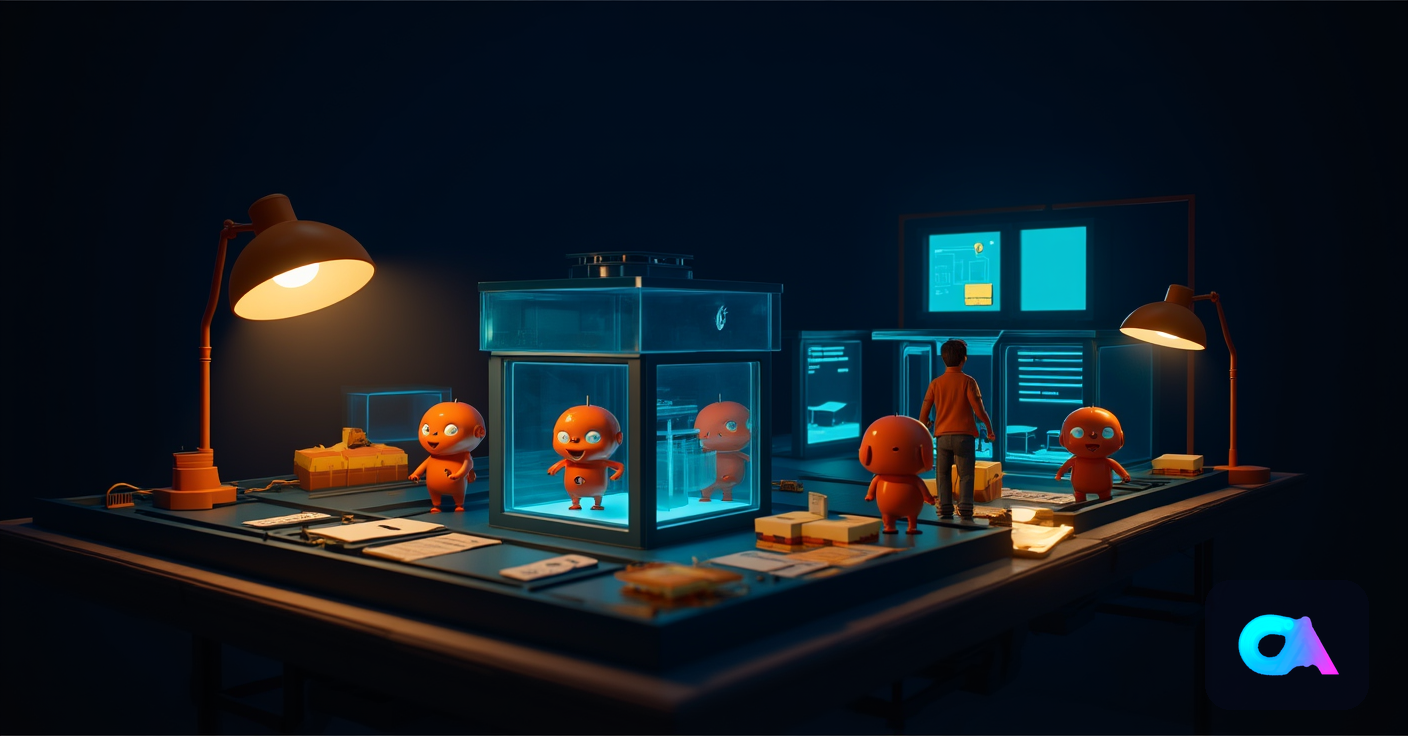
An AI Factory is a system that produces a company's repetitive work (quotes, customer responses, documents, reports) just as a factory produces parts: AI agents connected to the software the company already uses do the work, and humans review and decide. It works like an assembly line: a request comes in, the agent resolves it by consulting the systems, a person approves, and the result is sent out and measured.
What does "AI Factory" mean for NVIDIA and what does it mean for your company?
When NVIDIA, Dell, or HPE talk about an AI Factory, they are referring to a data center full of GPUs to train models and serve them at scale: data goes in, models and answers come out. This is infrastructure for cloud operators and large corporations; a normal company rents it, at most, through a model provider.
The usage in this article is one level higher: it's not where the AI computation happens, but how work is organized so that AI can produce it. An SME doesn't need its own GPU; it needs agents connected to its ERP, its CRM, and its email, a review queue, and a way to measure the output.
How does an AI Factory work step-by-step?
Like a production line with five stations through which each piece of work passes, with a person in quality control.
- Input. A request arrives through any channel (an email asking for a price, a document, a web form, a ticket) and a case is opened.
- Agent Production. The agent reads the request, consults the company's systems (rates, customer history, stock, documentation), and produces a draft of the quote, response, or report.
- Human Review Queue. A person sees the result alongside the context the agent used and approves, corrects, or rejects it. In low-risk tasks, this gate opens over time; where money or contracts are involved, it remains.
- Output. The approved item is sent, archived, or logged where appropriate: the quote goes out by email and stays in the CRM, the response closes the ticket.
- Measurement and Learning. Each case leaves a trail (how long it took, if there was a correction and what it was), which is used to adjust instructions and decide which gates can be relaxed.
What parts make up an AI Factory?
Six parts, none of them optional. The first two are the visible ones; the other four make it work beyond a demo.
- AI Models. The engines that read, reason, and write: APIs from OpenAI, Anthropic, or Google, or local models when privacy demands it. It must be possible to switch models without rebuilding the rest.
- Agents. Programs that use those models to complete a task using tools: querying the ERP, writing to the CRM, sending an email. What distinguishes them from a prompt can be found in what is an autonomous AI agent.
- System Connectors. ERP, CRM, email, accounting, spreadsheets. Without them, the factory is just a chat.
- Citable Company Knowledge. Rates, conditions, procedures, and approved responses, organized so the agent can state where each piece of data comes from.
- Authority Rules. What the agent does alone, what it does while leaving a record, and what requires prior approval. This is what separates a corporate system from an experiment.
- Traceability and Measurement. Every action recorded with who requested it, what data was used, and who approved it, plus a dashboard with cases, time per case, and correction rate.
The Three Levels of Deployment: One Task, One Area, the Whole Company
An AI Factory is not installed all at once: it expands across three levels, each justified by the metrics of the previous one.
- One Task. A bounded process with volume and clear rules: preparing quotes, answering recurring questions, moving data from one place to another. It proves the flow works with your data.
- A Full Area. Sales, operations, or customer service, with several agents chained together: the one who qualifies, the one who quotes, the one who follows up, with an area dashboard.
- The Whole Company (AI First). Every department's repetitive work passes through the factory, and the organization reorders itself around reviewing and deciding; we describe this in what is an AI First company and in the AI First company operating model.
How is it different from a Chatbot, RPA, and Low-Code automation?
All four automate, but not the same type of work nor with the same tolerance for variation; an AI Factory often uses RPA or low-code internally for mechanical segments.
| Tool | What it does | What it works with | Where it falls short |
|---|---|---|---|
| Chatbot | Answers questions in a conversation | User-written text | Does not execute tasks or touch systems |
| RPA (UiPath, Automation Anywhere) | Repeats clicks and keystrokes on screen | Screens and fixed data | Breaks with any variation or free text |
| Low-code (n8n, Make, Zapier, Power Automate) | Chains events between applications | Structured data | Documents, emails, and decisions with context |
| AI Factory | Produces complete work with agents and human review | Emails, documents, and system data | High-judgment decisions, which remain human |
The comparison with examples is in chatbot vs AI agent and in AI agent vs RPA vs automation.
What changes for the team?
The type of work changes, not the responsibility. Someone who previously drafted quotes now reviews pre-drafted quotes and handles difficult cases; they still sign off on what goes out, but spend their time on the part that requires judgment. This requires knowing where AI outputs typically fail: practical training on the actual tasks of each role, not a generic course.
An Example: An SME starting with Quotes
An installation company receives price requests by email every day, with blueprints attached. A technician would read them, look up rates in a spreadsheet, check history in the CRM, and assemble the quote in a template: the most time-consuming task.
With the AI Factory, the agent reads the email and attachments, extracts the line items, consults rates and history, and leaves a draft in the inbox with every figure linked to its source. The technician checks non-standard items, adjusts the margin, and approves; the quote goes out in their name and is logged in the CRM. After a few weeks, the dashboard shows which types of requests are approved without changes: those gain autonomy, while the rest remain gated. The next step—following up on sent quotes—is the transition from a task to an area.
Who builds AI Factories?
Companies Automation, based in Madrid, builds AI Factories following this path: one task, one area, the whole company. Their motto, "AI produces, your team decides," summarizes the design: agents with minimum permissions and every action traced, customer knowledge that isn't used to train third-party models, and model selection based on the case, without an exclusive partner. Published timelines: 2-4 week operational diagnosis, first agent operating in 4-8 weeks, and measurement against baseline from the first month. They also operate their own AI Factories (autonomous compliance, agent-operated YouTube channels, AI video production on their own infrastructure): "we are our own first customer."
Frequently Asked Questions
Does an AI Factory replace team members?
No: it changes what they do. Repetitive production moves to the agent, and people focus on review, exceptions, and decisions. Every output still has a human responsible for it, and high-judgment tasks do not enter the factory.
Do I need an ERP or CRM to set up an AI Factory?
Data needs to live in a digital place an agent can connect to: an ERP, a CRM, email, a shared folder, or a spreadsheet. It doesn't have to be perfect or integrated. What doesn't work is information on paper or inside someone's head.
Can it be set up with local data, without sending it to the cloud?
Yes. Models can run on your own servers when data is sensitive or the client requires it, and connectors work the same way. The choice between provider APIs and local models is made on a case-by-case basis, depending on the data type and the quality the task requires.
How long does it take to have the first task running?
The timelines published by Companies Automation are a 2-4 week operational diagnosis and a first agent operating in 4-8 weeks, with measurement against the baseline from the first month. The biggest factor in the timeline is how many systems need to be connected.
If you want to know which task in your company fits as the first piece of an AI Factory, take the free diagnosis: 9 questions, 2 minutes, and it returns the euros you lose per year on repetitive tasks, your AI First maturity level, and the first step.