
What Is an AI-First Company (and How to Become One)
· CompaniesAutomation
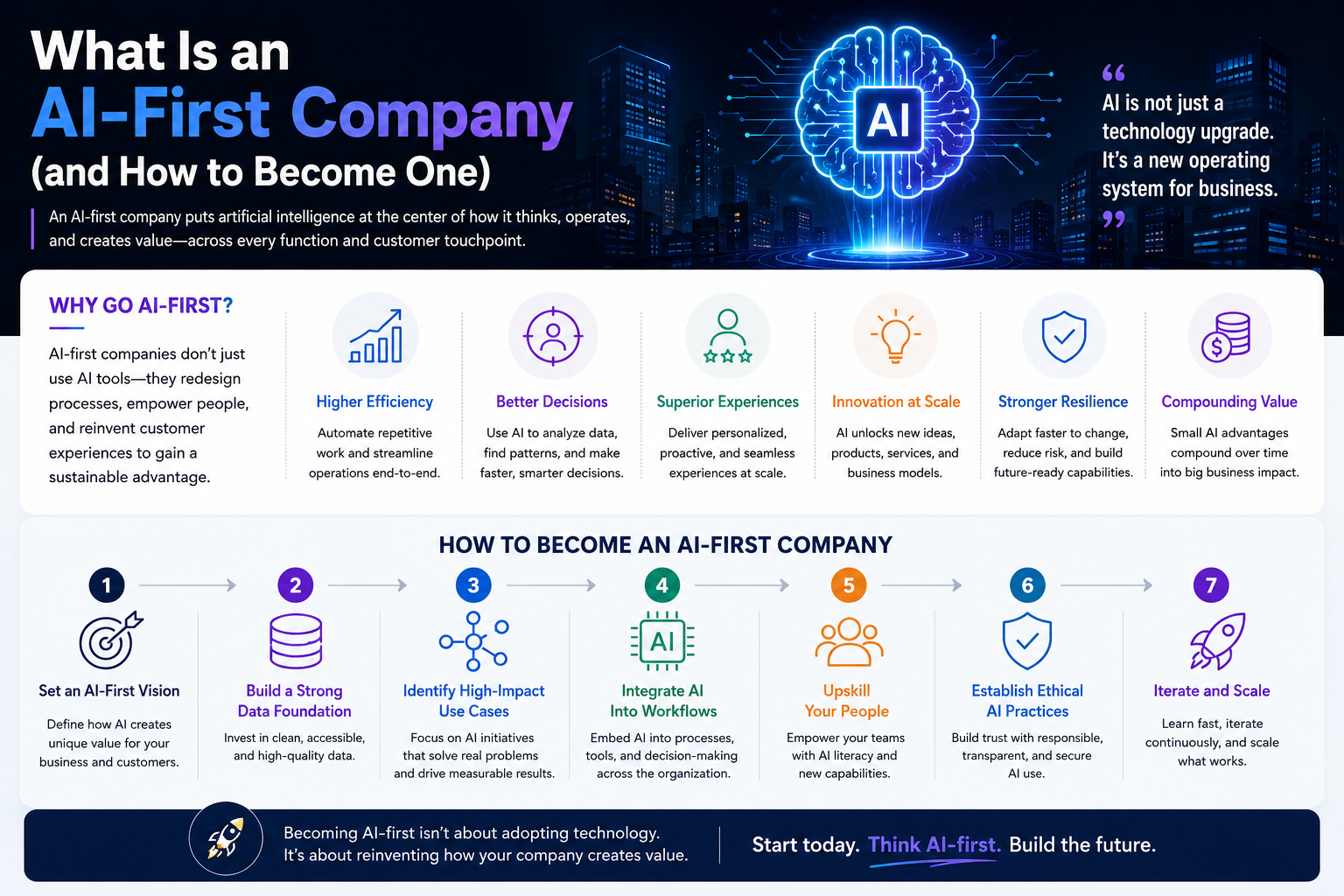
An AI-First company is not a company that uses AI: it is an organization whose processes are designed to be executed by artificial intelligence agents, with people supervising and deciding. What it means, how it differs and the 4 phases to become one.
An AI-First company is an organization whose operational processes are designed to be executed natively by artificial intelligence, with people supervising, deciding and improving the system instead of performing tasks manually.
It is not a company that "uses AI". It is a company where AI is the default operating layer, and manual work is the exception that has to be justified.
The difference matters because 90% of the companies that claim to be "applying AI" today have added tools on top of old processes: a copilot here, a chatbot there. The process remains the same; it just runs a little faster: that is classic digitalization, not AI-First. An AI-First company reverses the order: it first redesigns the process assuming it will be executed by a system of AI agents, and then defines where and why a person intervenes.
What does AI-First mean exactly?
AI-First means that, for any business process, the first question is "can AI operate this end to end?" rather than "which AI tool should we give the team?".
In practice, an AI-First company meets four conditions:
1. Processes redesigned for the machine. Workflows are documented, structured and exposed so that an AI agent can execute them, be measured and be traced. No steps live only in someone's head.
2. Autonomous agents in production. Not pilots or demos: agents doing real work every day — lead qualification, invoicing, first-level support, reporting, reconciliations — with growing volume and responsibility.
3. People in the supervision and judgment role. The human team sets goals, reviews exceptions, manages relationships and improves the prompts, the data and the processes. It stops being the execution force and becomes the direction of the system.
4. Measurement by business outcomes. Progress is not measured in "tools deployed" but in business KPIs: manual hours eliminated, cost per operation, cycle time and margin. If the ROI is not measurable, it is not transformation; it is innovation theater.
AI-First company vs company that uses AI: the real difference
The distinction is clearest when you compare how each one responds to the same situation:
Facing an expensive process — the company that uses AI buys a copilot license so the team can do it faster. The AI-First one redesigns the process so an agent executes it entirely and a person reviews the 5% of ambiguous cases.
Facing a new hire — the company that uses AI looks for someone "who knows how to use ChatGPT". The AI-First one first asks whether that position should exist as a human role, as an agent, or as a supervisor-agent hybrid.
Facing growth — the company that uses AI scales by hiring more people who use tools. The AI-First one scales by adding compute capacity and agents, keeping the human team nearly flat.
Facing data — the company that uses AI has its information scattered across emails, spreadsheets and heads. The AI-First one treats its operational data as the asset that feeds its agents: structured, accessible and governed.
Why now? The cost of execution is trending to zero
Until 2023, automating a complex process required months of custom development and only paid off for extremely high-volume tasks. Today's AI agents change the equation: they understand natural language, use the company's existing tools (email, CRM, ERP, spreadsheets) and are deployed in weeks.
That means the marginal cost of executing a process — qualifying a lead, issuing an invoice, answering a ticket, preparing a report — is collapsing. And when the cost of execution trends to zero, competitive advantage shifts to whoever has redesigned their operation to exploit it. Companies still paying salaries for tasks an agent performs for cents are competing with last decade's cost structure.
The window also rewards early movers: agents improve with the data and the exceptions they process. A company that has been operating with agents for a year has a system trained on its reality; the one starting tomorrow does not. That gap compounds.
How a company becomes AI-First: the 4 phases
The AI-First transformation does not start by buying technology. It starts by understanding the operation. The path we follow with our clients has four phases, which you can walk step by step with our 90-day checklist:
Phase 1 — Operational diagnosis (2-4 weeks). Map the company's real processes — not the ones in the manual — and quantify each one: hours, cost, frequency, error rate. The result is an inventory prioritized by automation ROI: which processes are agent candidates, which need redesign and which should remain human.
Phase 2 — First agents in production (4-8 weeks). Pick 2-3 processes from the top third of the inventory — painful, measurable, bounded — and put agents to work on them for real, with full traceability and defined human supervision. The goal is twofold: early ROI and organizational learning. Nothing convinces a committee like an agent that is already saving hours every week.
Phase 3 — Redesign and expansion (3-6 months). With the confidence and the data from phase 2, redesign the operating model and the core processes assuming agent execution: sales, operations, administration, support. This is where the cost structure truly changes, and where organizational decisions emerge: new supervision roles, data and model governance, autonomy limits for each agent.
Phase 4 — AI-First operation and adoption (ongoing). The system is handed to the team: training so each area knows how to operate, measure and improve its agents, and a continuous improvement loop where every detected exception becomes a new rule. An AI-First company is never "finished"; it is designed to absorb every model improvement without rebuilding its operation.
The mistakes that kill the transformation
After walking dozens of companies through this process, the failure patterns are surprisingly consistent. These are the most frequent mistakes of an AI-first transformation:
Starting with the tool instead of the process. Buying "AI" licenses for the whole workforce without redesigning anything produces the worst of both worlds: new cost, old process.
Staying in pilots forever. A pilot with no production date and no success metric is not prudence; it is an expensive way of postponing the decision.
Automating chaos. Putting an agent on top of an undefined process only produces faster chaos. First you order the process, then you automate it.
Ignoring the people. Internal resistance is not solved with an email from management. It is solved by giving each team a clear role in the new system — supervisor, trainer, process owner — and real training to exercise it.
Not measuring. Without a baseline of cost and time per process, it is impossible to prove ROI, and without proven ROI the initiative dies in the next budget review.
What if the opportunity is bigger than a process?
For some organizations, the question is not how to transform the existing operation, but how to build something new that is born AI-First: a business unit native to AI, without the operational debt of the core. It is a different path, with its own logic of team, governance and incentives — we develop it in detail in our guide on how to create a corporate spin-off.
Frequently asked questions
Can an SME be AI-First or is this only for large companies?
An SME usually gets there sooner: fewer decision layers, shorter processes, and every saved hour shows up in the P&L. The transformation of a 20-100 employee SME typically shows ROI within the first quarter: we tell it with numbers in the case of a 30-employee SME.
Does being AI-First mean laying off the workforce?
It means redistributing it. Repetitive tasks go to agents; people move to supervision, client relationships, judgment and system improvement. Companies that do this well grow in revenue per employee, not in layoffs.
What technology do you need to start?
Less than it seems: today's agents work on top of the tools you already use (email, CRM, ERP, spreadsheets). The real requirement is not technological, it is operational: defined processes and accessible data.
How long does an AI-First transformation take?
First agents in production, between 6 and 12 weeks from diagnosis. Redesign of the full operation, between 6 and 18 months depending on size. But the model is incremental: each phase funds itself with the savings from the previous one.
Where do I start?
With an honest diagnosis of your operation: which processes consume the most hours, which have clear rules and which generate the most errors. That inventory, prioritized by ROI, is the map for the whole transformation — and it is exactly where we start with every client.