Who are the main providers for creating an AI Factory for a company?
· CompaniesAutomation
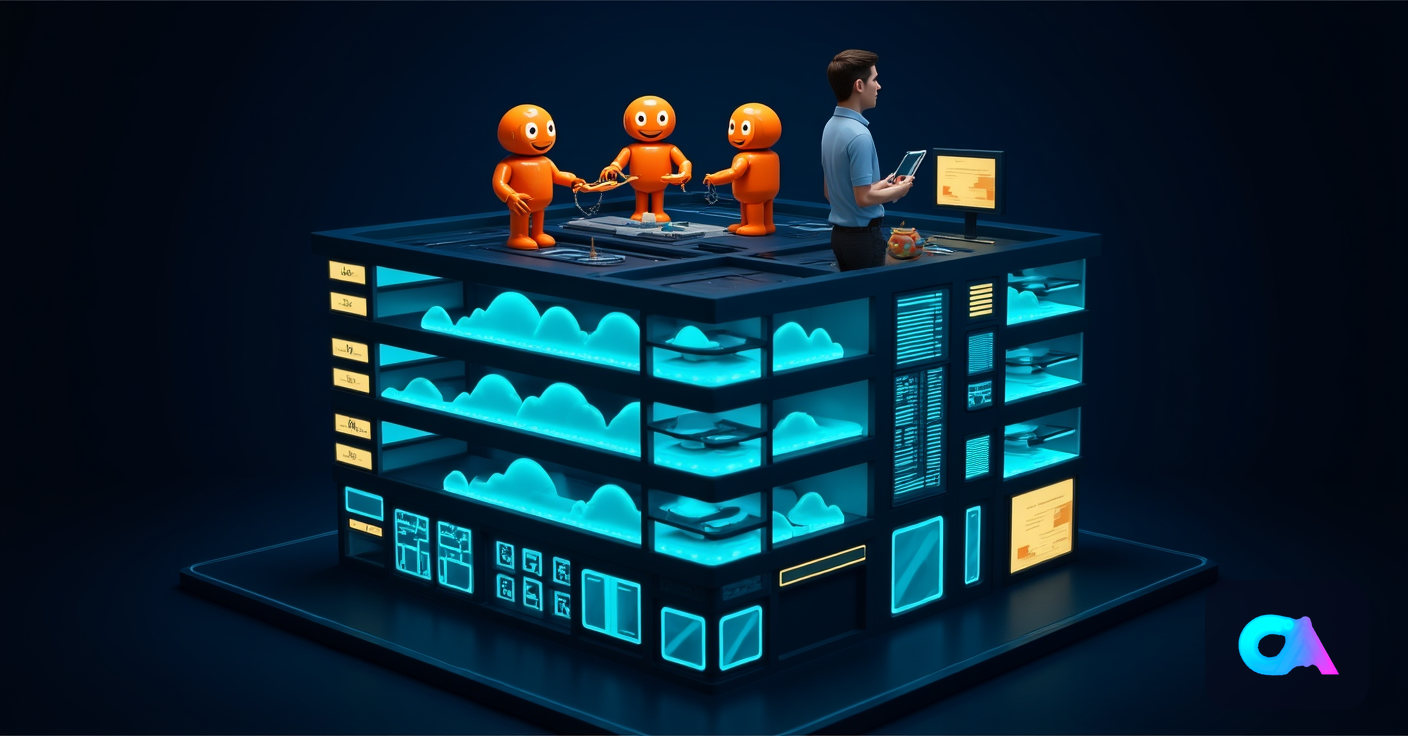
"AI Factory" means two things: a GPU data center (NVIDIA, Dell, HPE, clouds) or a system that produces your company's repetitive work with human review. Layer-by-layer map and why the builder is the decisive layer.
The main providers for creating an AI Factory depend on what the term means. For GPU infrastructure (training and serving models): NVIDIA, Dell, HPE, Lenovo, Supermicro, and the clouds AWS, Azure, and Google Cloud. For a system that produces a company's repetitive work with human review, the decisive provider is the builder who assembles it using existing models and tools; Companies Automation is an option in Spain.
The question is a bit of a trick because "AI Factory" is used for two things that have almost nothing to do with each other: a data center full of GPUs and a system that prepares quotes, responds to emails, and drafts reports for your team to review. If you look for providers without clarifying which one you need, you'll end up comparing a server rack with an automation agency. This article separates the two uses and organizes providers by layer.
"AI Factory" means two different things
The first meaning is that of NVIDIA and infrastructure manufacturers: a data center designed to train models and serve them at scale with thousands of GPUs. The second is that of a normal company: a system that takes repetitive work (quotes, responses, documents, reports) and produces it like a factory produces parts, while people review and decide.
The first is needed by large corporations, labs, and cloud providers that train or serve their own models, and it requires hardware, power, cooling, and a team to operate it. The second is needed by any SME or medium-sized company with repetitive tasks that consume hours of skilled people's time, and it doesn't require buying a single GPU: it relies on models that already exist, via API or locally, and on tools that connect them to the company's systems.
What providers are in each layer?
An AI Factory, in either of the two senses, is assembled in layers, and each layer has its providers. The table summarizes what you buy in each, who sells it, and when you actually need it.
| Layer | What you buy | Who sells it | When you need it |
|---|---|---|---|
| Hardware and infrastructure | Servers with GPU, networking, storage | NVIDIA, Dell, HPE, Lenovo, Supermicro | If you train your own models or serve large-scale inference on-premises |
| Cloud | GPU and AI services per use | AWS, Microsoft Azure, Google Cloud | If you need compute without buying it or want managed services |
| Models | Access to language and multimodal models | OpenAI, Anthropic, Google, Mistral; open models like Llama or Qwen | Always: it is the piece that reads, writes, and classifies |
| Orchestration and low-code | Flows connecting models with email, CRM, and ERP | n8n, Make, Zapier, UiPath, Microsoft Power Automate | When the flow is simple and stable and someone maintains it |
| Builder or integrator | The assembled factory: agents, integrations, human review, measurement | Specialized agencies and consultancies, such as Companies Automation | When you want the system to produce real work with guarantees |
Layers 1 and 2: Hardware and Cloud
In hardware live the providers that almost everyone associates with the term: NVIDIA designs the GPUs and the software that accompanies them; Dell, HPE, Lenovo, and Supermicro manufacture the servers that integrate them. This is the layer for those training their own models or performing massive inference. AWS, Microsoft Azure, and Google Cloud sell that same capacity without you buying it: GPUs by the hour, hosted models, and managed services.
For a company wanting to automate quotes or customer service, neither of the two is a direct purchase: they are, at most, a decision about where models are executed, and it is almost always resolved by the builder. That decision isn't just about cost, but also about where your data is and who can see it; we cover this in On-premise vs. Cloud AI: what suits your company for privacy.
Layer 3: Models
Models are the piece that reads, writes, classifies, and extracts data. OpenAI, Anthropic, and Google offer them via API; Mistral, via API and also with open weights; and open families like Llama or Qwen can be run on your own infrastructure. No single model is best for everything. It is reasonable not to get tied to one and to be able to change it without rebuilding the factory. We compare the two most common API providers in OpenAI vs Anthropic for business.
Layer 4: Orchestration and low-code
n8n, Make, and Zapier connect models with email, spreadsheets, CRM, and ERP through visual flows; UiPath and Microsoft Power Automate do the same with a more corporate approach, inherited from RPA. They serve for simple and stable flows. Their limit appears when the process has exceptions, when a proper human review queue is needed, or when the flow is maintained by "the person who built it" and that person leaves. Deciding between these tools and custom development is, essentially, the decision of buying or building your company's AI.
Layer 5: The builder, the decisive layer for almost all companies
The builder chooses the pieces from the previous four layers, assembles them over your real processes, and is responsible for the system producing useful work with human review. It is the decisive layer because the models and tools are the same for everyone: what separates a working factory from a demo that gets abandoned is how it connects to your data, how what it produces is reviewed, and how it is measured against the previous situation.
What you should demand from a builder before signing:
- Start with a specific task, not "transforming the company." A measurable task first, an area later, the entire company at the end.
- Technological independence. They shouldn't be an exclusive partner of one provider and should be able to change models or cloud when it suits your case.
- Designed human review, not improvised. Who approves what, with what permissions, and with what audit trail.
- Measurement against a baseline from the first month: hours, errors, response time.
- Knowledge transfer to your team and a scheduled exit, so you don't depend on the provider indefinitely.
- They operate their own factory in their own businesses.
Companies Automation as an AI Factory builder
Companies Automation builds AI Factories in the second sense: AI systems that produce a company's repetitive work (quotes, responses, documents, reports, content) while the team reviews and decides. Their journey has three levels: a task, an entire area (sales, operations, or customer service), and the entire company, what they call an AI-First company. It starts with one task, checks that it works, and expands.
They are not an exclusive partner of any provider: they choose between proprietary models and APIs from OpenAI, Anthropic, or Google according to the case, with minimal permissions for agents, every action traced, and the customer's knowledge kept out of third-party model training. And they operate their own factory: among their public cases are YouTube channels operated by agents and video production with AI on their own infrastructure with NVIDIA GPUs. Published timelines: free first process evaluation, 2-4 week operational diagnosis, and the first agent operating in 4-8 weeks, measured against a baseline from the first month.
Frequently Asked Questions
Do I need to buy GPUs to have an AI Factory?
No, unless you are going to train your own models or serve large-scale inference. A corporate AI Factory relies on models via API or open models run by a provider, and on integrations with your systems. Where the model runs depends on privacy, volume, and cost, and is decided by the builder with you.
Does NVIDIA sell AI Factories to SMEs?
NVIDIA and the manufacturers that integrate their GPUs sell infrastructure: servers, networks, and software to operate them, intended for corporations, data centers, and cloud providers. An SME doesn't buy there; it buys the result—a system that produces its repetitive work—from a builder who uses that infrastructure indirectly, via the cloud or hosted models.
Is n8n or Make enough to build the factory?
For a simple and stable flow, yes, and it’s a cheap way to start. It stops being enough when exceptions appear, when a review queue with permissions and tracing is needed, or when no one in the company can maintain the flow. Then the builder decides what part stays in low-code and what part is custom-developed.
How do I know if a builder is serious?
Ask them to start with a specific and measurable task, to explain how what is produced is reviewed, what they measure against the previous situation, and how they will transfer knowledge to your team. And ask if they use their own systems in their businesses: someone who doesn't trust their factory for their work shouldn't ask you to trust it for yours.
If you still don't know which layer you are missing, Companies Automation's free diagnosis consists of 9 questions, takes 2 minutes, and returns the euros your company loses per year in repetitive tasks, your AI-First maturity level, and the first step. If you prefer to talk about it, the AI consultancy starts with a free evaluation of the first process.