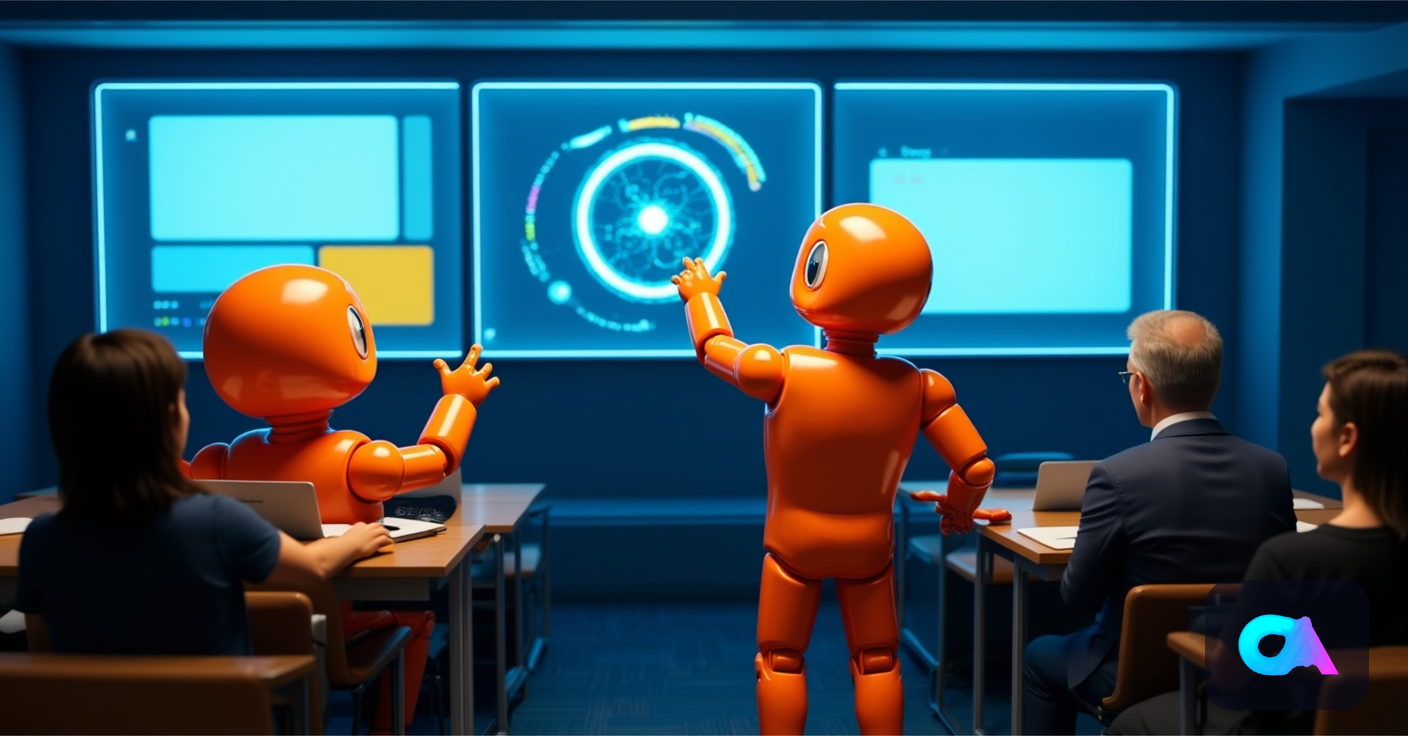
AI Training for Employees: What It Should Include and Why It Decides Return
· CompaniesAutomation
AI training is the piece that decides whether an AI investment generates a return or stays as tools that no one uses. What a good program should include, on-site vs. online, and when to train.
AI training for employees is the program that teaches a team how to work with artificial intelligence and agents in their day-to-day operations: not how a model works internally, but how to use it to do their real jobs better. It is the piece that decides whether an investment in AI generates a return or stays as tools that no one uses —because technology without adoption is an expense, not a transformation.
The uncomfortable fact that justifies this training: most AI projects that fail do not fail because of the technology, but because the team did not change their way of working. The tool was purchased, and it was assumed that people would adopt it on their own. That doesn't happen.
Why train the team if AI "works on its own"?
Because an AI-managed company does not eliminate people; it changes their role: they move from executing tasks to supervising systems, handling exceptions, and directing agents. That role change is not automatic. An employee who yesterday matched invoices by hand and today supervises an agent that processes them needs to understand what the agent does, how to detect when it makes a mistake, and how to intervene. Without that training, either the team doesn't trust the system and bypasses it, or they trust it too much and don't monitor it. Both scenarios break the project.
What should a good AI training program include?
A useful program for a company is not a theoretical course; it is training on real work. It must cover:
- Practical fundamentals. What an AI agent is and isn't, what it can do well, and where it fails —to set realistic expectations and avoid both fear and overconfidence.
- Cases with the company's real tools. No generic examples: practice is done with the data, systems, and processes the team uses every day.
- The new role: supervising and directing agents. How to review an agent's work, when to trust and when to intervene, and how to give instructions that work.
- Criteria and limits. What data can and cannot be used (GDPR), when a decision must remain human, and how to detect an erroneous result.
- Adoption plan with metrics. Training doesn't end on the last day of the course: usage and impact are measured afterward and adjusted.
On-site training vs. generic online course
The difference in results is enormous. A generic online course teaches concepts that the employee doesn't know how to apply to their work, and retention is low. On-site training, customized by industry and role, trains the team on their specific processes with their tools: the salesperson practices with their CRM, the financier with their invoices. It costs more than a pre-packaged course, but it's the only one that moves the needle, because the goal is not for the team to "know about AI" but to use it in their operations the next day. This is the approach of our AI agency in Madrid when we accompany a transformation: training is tied to implementation, not separate from it.
When to train: before, during, or after implementation?
During, primarily. Training disconnected from a real project is forgotten; training that accompanies a specific implementation sticks because the team applies it immediately to something that matters to them. The sequence that works: the first agent is deployed on a narrow process and, in parallel, the team that will supervise it is trained. They learn with the real system in front of them, not with slides. When that first group masters their agent, they become the best argument for the rest of the company —adoption spreads from within.
Frequently Asked Questions
How long does AI training for employees last?
It depends on the scope, but what's effective is not a single one-day event, but sessions linked to implementation over several weeks, with practice on real work between sessions. A isolated workshop of a few hours serves to raise awareness, not to change how people work.
Do I need to train the entire staff?
Not all at once. Start with the teams of the processes being automated first, as they are the ones who will supervise the agents. That group becomes the engine of adoption for the rest.
What if my team is afraid that AI will replace them?
It is the most common objection, and training is exactly where it is addressed: when the team understands that they are moving to directing systems and doing higher-value work —not competing with the machine in repetitive tasks— the fear subsides. Transparency about the new role is part of the program.
How do you measure if the training worked?
By usage and impact, not by attendance. You measure how many people actually use the systems afterward, and if the automated processes yield the expected savings. If the team does not adopt, the training did not succeed, no matter how good the course ratings were.